Workout plan
General information
The workout plan is the basic element that all workout plans created by coaches for athletes consist of. In general, it is information from the coach regarding the training tasks that should be completed on a specific day by the selected athlete.
Each workout plan has a specific mandatory:
- Activity type - a training category to make it easier to understand your training and later group your plans according to what types of training units they involved (e.g. Intervals, Running, Strength Training). More...
- Workout name - the name of the workout, which makes it easier to distinguish between workouts and find them in the calendar
In addition, the workout plan may include:
- Description - a description of the workout to give you a better understanding of the workout and its purpose
- Duration - the target duration of the workout
- Distance - the target distance of the workout
- Altitude gain - the target altitude gain of the workout
- Effort - the target training effort defined as RPE
Saving workout plan as draft
A workout can be saved as a draft, which means that it is not yet available to the athlete. In this case, the coach can edit it, delete it, copy it, but it is not visible to the athlete. Only after the workout has been published will it be available to the athlete.
Once published, the athlete will also be notified when a new training plan has been added for him.
Definition of training structure (intervals, series, repetitions)
The training plan can include a workout structure that allows the definition of intervals, series, repetitions, rest time between series, rest time between repetitions and target intensity level. This allows the coach to define what the workout should look like and the athlete to complete the workout according to the coach's recommendations.
This functionality is mainly for Garmin, COROS, Suunto and Apple watch owners, as it is possible to export such a prepared plan, and this plan, once synchronised with a Garmin (or COROS) watch, will appear for completion on that watch.
The structure of the training sessions can only be defined by the coach using the browser application.
The plan will not be available as a graphical preview in mobile applications. If defined, it will be displayed in descriptive form.
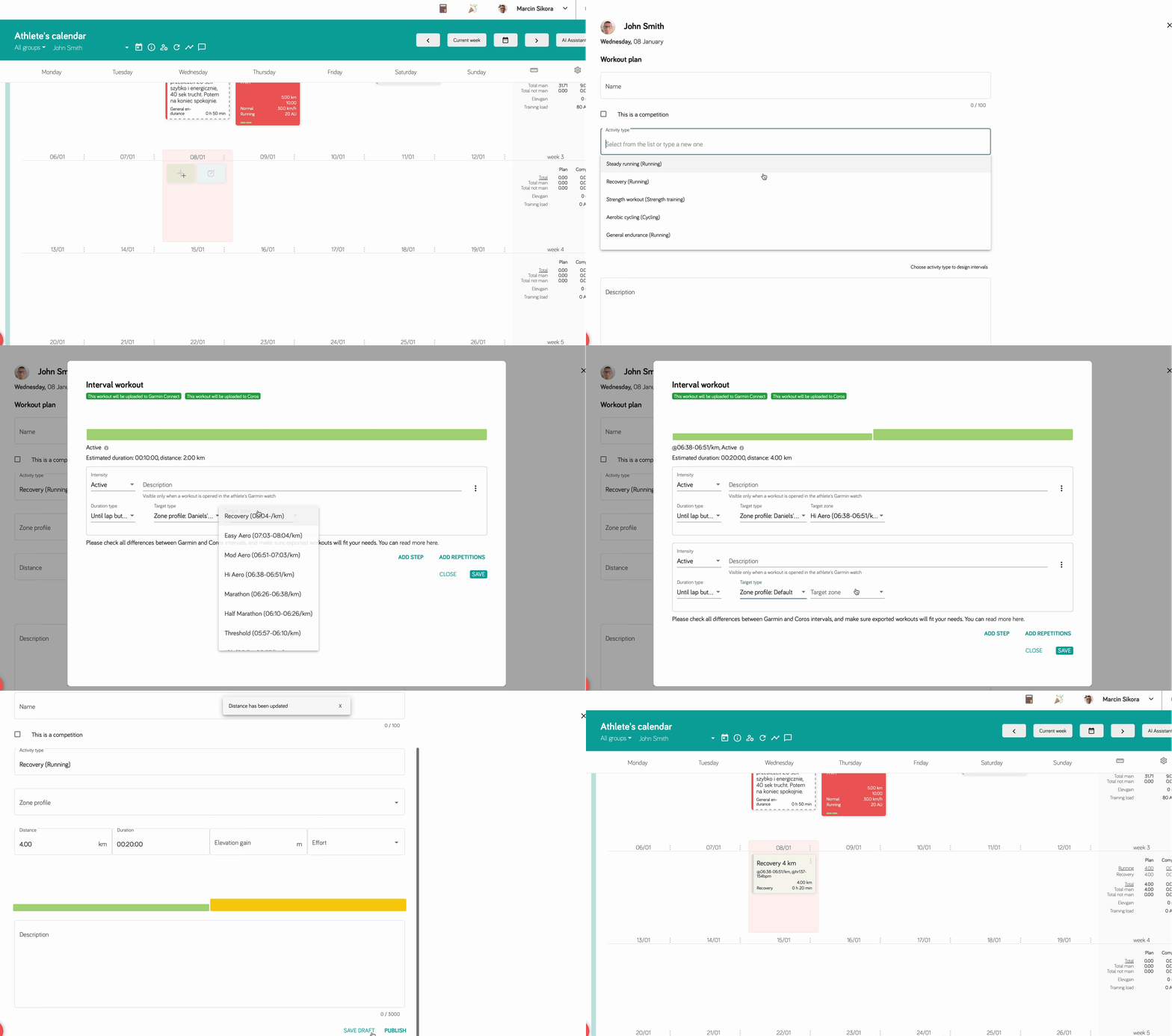
Using training zones in intervals
Each step of a structured workout can target a training zone. The step shows the zone with this athlete's values, and the watch receives it as a range in heart rate, pace or power. When the athlete's metrics or zones change later, the step's target follows — see Cascading updates.
Defining strength training structure
In the case of selecting an activity type with the sport type Strength training, it is possible to define the structure of strength training. In this case, the coach can select exercises that should be performed as part of a given workout, as well as specify the number of series and repetitions.
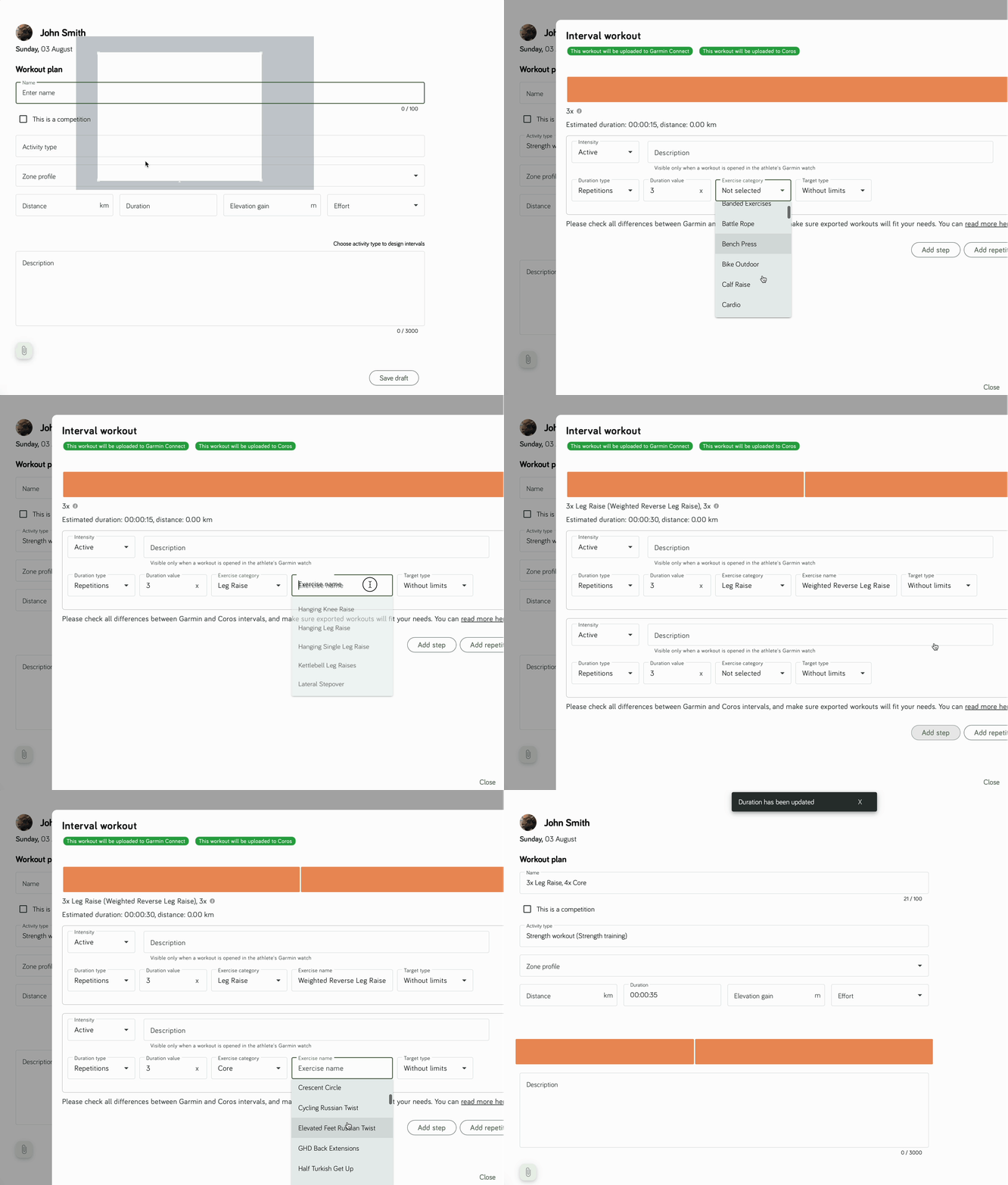
All exercises defined in the Garmin exercise database are available for selection. When synchronising such a training plan with a Garmin watch, the watch will (depending on the model) contain more information about the given exercise. In the case of other watches, the name and category of the exercise will be included in the workout description (only in English), and the athlete will be able to perform the exercise according to the coach's recommendations.
There is a possibility that the strength training will not appear automatically for selection in the Garmin watch when starting an activity of type Strength. In this case, it should be selected from the training calendar according to this instruction
Auto-calculated fields
Overview
The workout plan's main fields — Duration and Distance — can now be automatically calculated based on the intervals defined in the workout structure. This creates a seamless link between the detailed interval design and the top-level workout summary, saving coaches time and reducing manual errors.
How it works
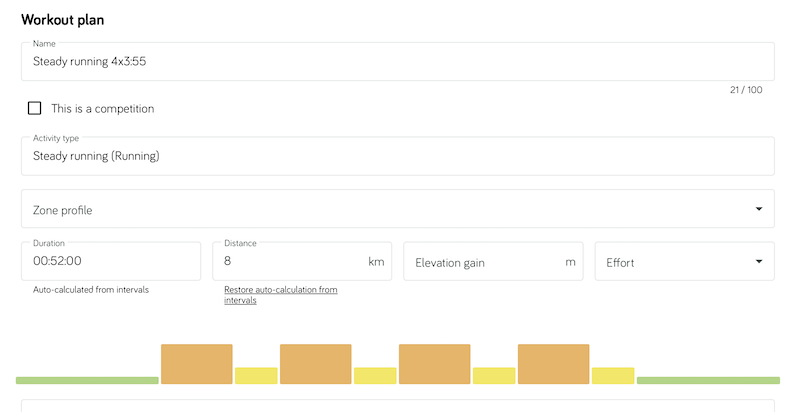
Each workout plan's Duration and Distance fields have an auto-calculation mode, enabled by default in new workouts and templates when structured intervals are defined. Below each field, a label reads: "Auto-calculated from intervals."
When a coach manually changes a value, auto-calculation is disabled for that specific field only. The label changes to a clickable "Restore auto-calculation from intervals" link, allowing the coach to re-enable it at any time. This preference is saved with the workout, so it persists across future editing sessions.
This means coaches can work in two modes: let the system handle the math when building interval-based workouts, or take full control when they have a specific target in mind.
Requirements for accurate estimation
Auto-calculation relies on the athlete's recorded performance metrics to estimate effort for each interval. The key metrics used include:
- Maximum heart rate
- Resting heart rate
- 10 km running pace (for running workouts)
A step in the athlete's individual pace zones needs none of these: its paces are the athlete's own, so its duration or distance is calculated from them directly, at the middle of the zone. A step in anaerobic threshold pace zones works the same way — it only needs the athlete's threshold pace, or a 10 km time to work it out from. Heart-rate zones and Daniels' Paces do need the 10 km time, and the interval designer warns you only when a step actually needs a metric that is missing.
If these values are not available, the system attempts a fallback estimation, though accuracy may be limited. See athlete performance metrics for details on how estimated metrics are derived.
Live recalculation when opening a workout
When a coach opens a workout plan that has auto-calculation enabled, the system recalculates Duration and Distance on the spot. If the recalculated values differ from what was previously saved (e.g., because the athlete's metrics have changed), the coach is notified and prompted to save the updated workout.
Cascading updates on metric and zone changes
When a coach updates an athlete's performance metrics (such as 10 km pace, threshold pace or maximum heart rate) or their training zones, the system automatically propagates the change:
- The athlete's uncompleted workout plans from the past week to two months ahead are checked
- Interval intensity ranges and the workout's zone are recalculated based on the new values
- For workouts with auto-calculation enabled, Duration and Distance are updated accordingly
- Workouts from today on are sent to the athlete's watch again
This ensures that a single update keeps the entire upcoming training plan consistent — no need to manually revisit each workout. Which zone changes trigger it is described in Keeping planned workouts up to date.
Saving as a competition
Marking a workout plan as a competition has been replaced by a dedicated competition — its own kind of calendar entry, linked to a shared race event and carrying its own goal, result and discussion. You no longer turn a workout plan into a competition.
To enter an athlete in a race, add a competition to their calendar. See Races for the shared catalogue of race events.
Ways to add a workout plan
A workout plan can be added to the calendar by:
- Adding it manually from the calendar after entering all the necessary parameters.
- Copying another workout plan and pasting it on the selected day for one or more athletes.
- Adding it from the calendar level using a predefined template.
- Adding it from the calendar level using a predefined weekly template.
Workout plan date change
By default, the athlete is authorized to change the day of the workout plan by two days forward or backward on his own. The coach can change this setting altogether by forbidding independent changes, or by making it less restrictive and allowing changes within more days. The coach can make this change using the browser application, after accessing the Preferences screen in the top menu.
The athlete makes the workout plan date change himself:
- in the browser app by dragging the workout plan to another day,
- in the mobile app by selecting the option to change the date to another day.
In any case, the athlete should provide a reason for changing the day (the coach will be notified of the change, and it will be made visible on the training tile through an additional icon).
In case the coach does not allow the athlete to change the training date himself, the athlete dragging the training to another day sends a request to the coach for permission to change the training date, along with the reason for it. The coach will be notified of this request. The coach may accept or reject this request. The training will move to the new day only after the coach's approval.