Templates
A workout template is a workout plan predefined by the coach that the coach can assign to an athlete for completion. Workout templates can be created by the coach to facilitate the creation of workout plans for athletes. Workout templates can be assigned to multiple athletes to allow for easy management of workout plans.
Templates are used to add workouts more quickly. Once prepared, the templates are available on the "Templates" subpage. There, they are grouped by training type. For convenience, it is possible to change the order of templates within your group (just as you can change the order of training types where they are available for editing).
Templates are available for each user type, that is, both a coach and athlete can have their own templates. A coach who can manage the club's templates creates them for the whole club, so every coach in it works from the same library; otherwise a template stays private to the person who created it.
Each template contains exactly the same data as the workout plan. When creating a new template, only the name and activity type are mandatory. When you create a template from an existing workout plan, no additional input is required, because the template is simply a copy of the workout plan.
Browser application
Each day on the calendar has an Add button that groups all the actions for creating a new entry (workout from a template, workout plan, note, assessment, training break, health entry or event). The button follows a simple model: the Add button creates entries, while the three dots (⋮) menu manages the day.
The button has a primary action and a set of secondary actions:
- Primary action (a single click) depends on the context. For a coach it is Insert template; for an athlete it is Add workout plan (or Add workout completion on today and past days); on the events screen it is Add event.
- Secondary actions are available from the dropdown arrow next to the button (a bottom sheet on mobile) and let you create any of the other entry types.
On desktop, the Add button appears when you hover over a day in the week view and stays visible while its menu is open. On mobile, it is shown permanently in the single-day view, above the day summary.
To insert a template, use the Insert template action and then select the template. If the user is a coach the workout inserted from the template will be a draft. If you are an athlete, the workout will be published straight away.
Coaches can change which action is the primary one with the Primary add button: from template calendar setting (enabled by default). This setting has no effect for athletes.
It is also possible to create a template from a selected workout. Simply select a workout on the calendar, click on the menu of this workout and select "Save as template" from the context menu.
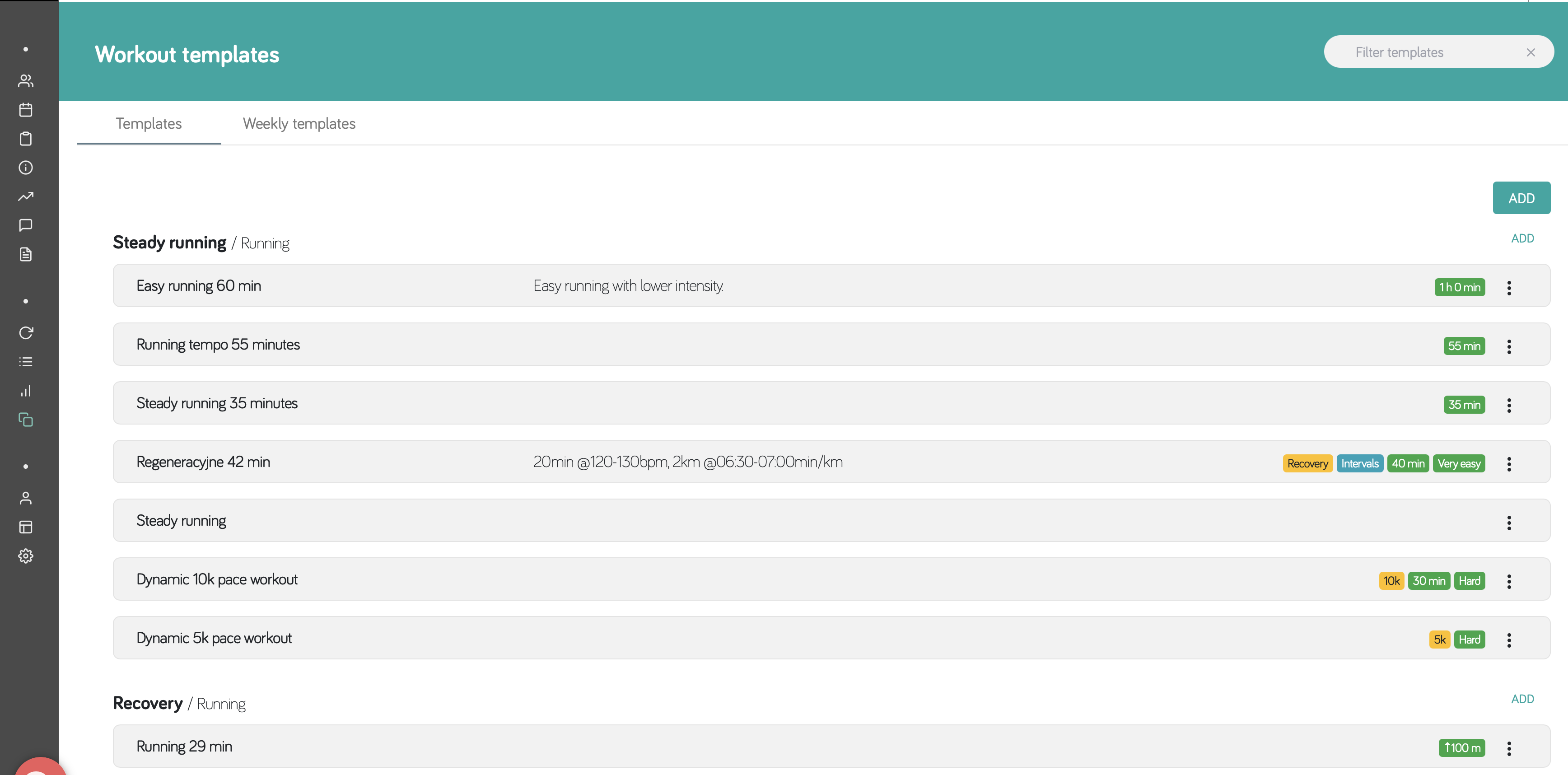
Folders
Once a library grows past a screenful, folders let you group templates the way you actually work — a training block, a pace group, a phase of the season — instead of encoding that structure in template names.
Folders belong to a tab: the Templates tab has its own and the Weekly templates tab has its own. A folder holds one kind of template and shows only on the tab it was created on, so "Marathon" can exist on both tabs and the two are independent of each other.
Creating a folder
Use New folder in the page header, next to Add. Folders are one level deep, so the button is there at the top level of a tab and disappears once you are inside a folder. On a phone there is no page header, so New folder is a tile of its own at the end of the folders — and the only tile there when you have none yet.
A folder can be empty — creating the container first and filling it afterwards is the normal way round. Names have to be unique within a tab, ignoring capitalisation and surrounding spaces, so VP1, vp1 and VP1 all count as the same name. If the name is already taken the app offers you the existing folder rather than creating a second one that reads identically.
A folder follows the same rule as a template. If you can manage the club's templates, the folder you create belongs to the club: everyone in it sees the folder, and the order you put it in is the order they see. If you cannot, the folder is yours alone and carries a Private badge — nobody else sees it, and its position is yours to arrange. Filing works the other way round from managing: any folder you can see will take a template from you, and what you put into a club folder stays yours and private — nobody else finds it there, and the folder looks unchanged to them. That holds for athletes too, so a coach's folder is somewhere they can keep their own work. What you cannot do is rename, reorder or delete a club folder, so those carry no ⋮ menu — not even one you created yourself while you could manage the club's templates. A club folder belongs to the club, and removing it would take the club's templates with it.
You can change your mind later, on the Templates tab. A folder's ⋮ carries Share with the club or Make private — in a club with more than one coach, and only if you can manage the club's templates. Moving something between the club's library and your own is the one thing that permission buys, so without it the option is not offered on a folder, a template or an activity type.
Share with the club moves nothing: your private templates are perfectly at home in a club folder, and they stay private.
Make private is the bigger step, because it hands you the folder and its contents. The folder becomes yours, and so does every club template in it — those leave the club's library, including ones another coach wrote. What is already your own private work simply stays put, and another coach's private template is not yours to take, so that one moves out to the top level and stays theirs. The app tells you this before it happens, and sharing the folder again does not undo it: what you took stays private.
Two things follow from the same rule — a folder has to be at least as visible as what it holds. A template you write inside a private folder is private, whether or not you manage the club's templates: that is what the folder is for, and it carries the Private badge as soon as it appears. An existing club template is the other case — you cannot move one in, because taking it out of the club's library is the template's own Make private, not something a drag should do quietly. And weekly folders have no privacy option at all: a weekly template's own visibility is fixed when you create it, so nothing could follow the folder across.
Putting templates into folders
There are three ways:
- One template — open its ⋮ menu and choose Move to folder. It is there even before you have made your first folder, because you can create one from the dialog.
- Several at once — click Select in the page header, tick the templates you want, then choose Move to folder in the bar that appears. Search still works while you are selecting, so you can type part of a name, take all the matches and move them in a single action. This is the quickest way to file an existing library.
- Dragging — on the Weekly templates tab you can drag a template straight onto a folder.
The move dialog also has New folder at the end of its list, so an empty library is not a dead end. Name the folder and save: the folder dialog closes, the move dialog comes back with the new folder marked in the list, and you click it to move the templates. Creating the container and choosing it stay two separate steps, so nothing moves until you say so. If the name you type belongs to a folder that already exists, the dialog offers Use it and brings you back to that folder rather than making a second one.
The same dialog moves templates back out: open it while you are inside a folder and choose Move out of the folder.
Working inside a folder
Click a folder to open it. The tiles are replaced by a breadcrumb — All templates › folder name — and the list below shows that folder's templates. Click All templates to come back out.
Templates you create while a folder is open are filed in it automatically, and so are duplicates. Templates saved from the calendar with Save as template always land at the top level, since no folder is open at that moment.
Each folder shows how many of its templates you can see; an empty one shows no number.
Ordering, renaming and removing
Folders are ordered by hand, and for a club folder that order is shared with the rest of the club. Drag a folder into the gap between two others to move it, or send it straight to either end with Move to top and Move to bottom from its ⋮ menu — easier on a touch screen, where dragging is awkward. Rename is in the same menu.
An empty folder goes as soon as you choose Remove folder — there is nothing in it to lose. A folder that holds templates asks first.
The confirmation carries a checkbox, Move the templates out of the folder before deleting it, ticked by default: the folder goes and its templates come back to the top level. Untick it and the templates are deleted along with the folder — the dialog then tells you how many will go and warns that it cannot be undone.
There is one exception. A workout template that is still used inside a weekly template is not deleted, because deleting it would strip a workout out of that weekly template. It is removed from the single templates list instead, and the weekly template goes on working.
Finding a template
The search box at the top of the page searches everything, not only the folder you happen to be looking at.
As soon as you type, the page switches from browsing to results. Matching folders come first under a Folders heading, then matching templates below them, still grouped by activity type. Each template result carries a small label naming the folder it lives in; templates at the top level have no label, which is what "not in a folder" looks like. Clicking that label opens the folder.
Because search looks everywhere, the breadcrumb is replaced by what you searched for while results are on screen. Clearing the search puts you back wherever you were.
If a folder name matches but nothing inside it does, you see the folder and a note that there are no matching templates.
Selecting several templates at once
Select in the page header turns on selection mode, on either tab. Tick the templates you want, or use the checkbox in the bar to take everything currently listed. Hold Shift while clicking to select a range.
From the bar you can Move to folder or Remove the selected templates. Removing asks for confirmation and cannot be undone. Done leaves selection mode.
Templates with training zones
A template can be planned in a training zone — for the whole workout, or for each step of its intervals. A template is not written for one athlete, so it offers every zone profile of the club for the template's sport — whoever is selected in the athlete switcher — and shows zone names without any athlete's values.
The values are filled in when the template is added to an athlete's calendar: each athlete gets their own, from their performance data or from their individual zones. The same template therefore fits every athlete you give it to. Estimated duration and distance are calculated for that athlete at the same moment.
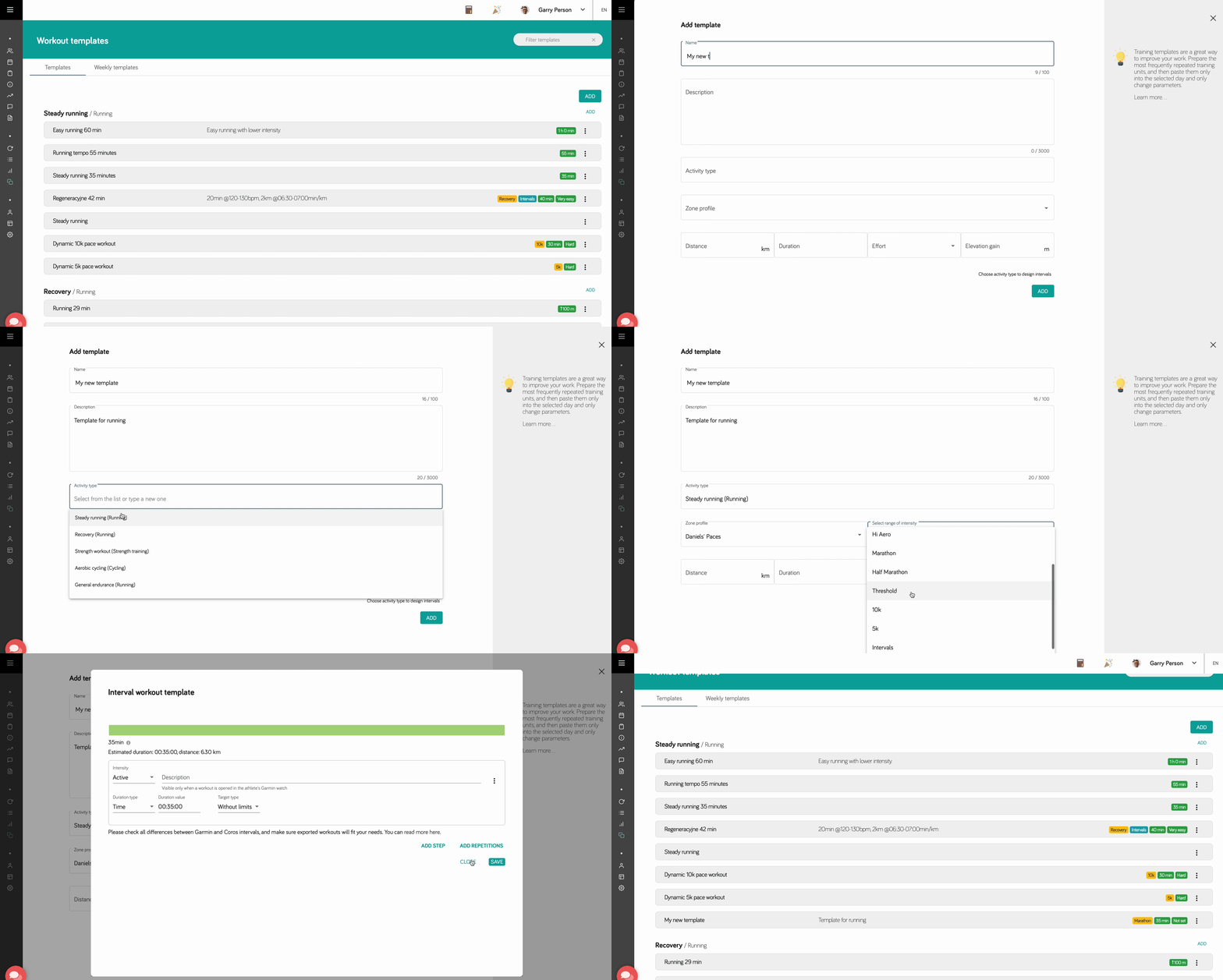
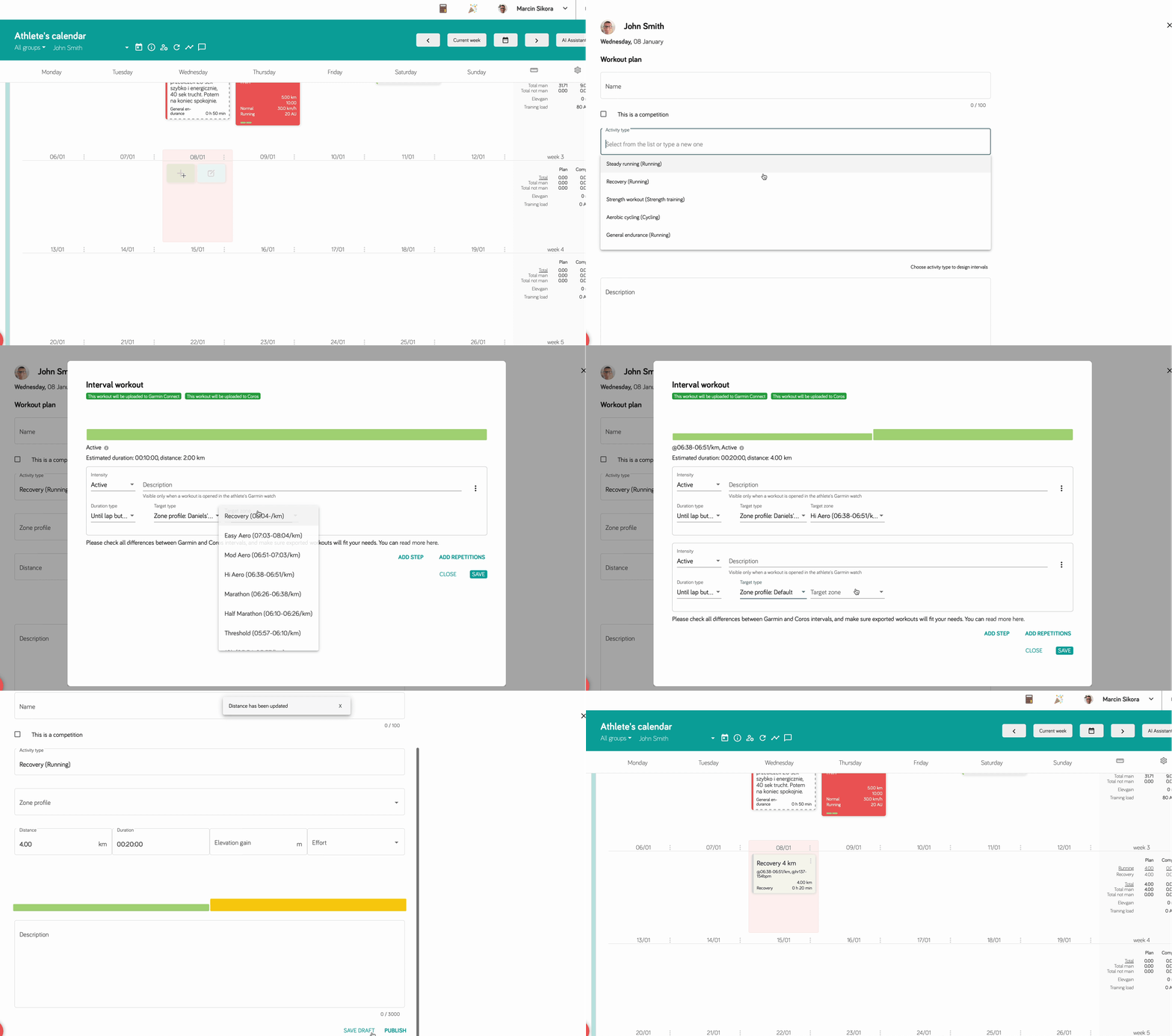
An athlete gets values only for zones they can have them for: zones based on metrics need the metric in their performance data (for example maximum heart rate, FTP or 10 km time), individual zones need their values filled in. Until then the workout shows the zone's name without a target — and fills in by itself once the data is there.
A template has no athlete, so the interval designer inside it does not estimate zone-based steps from anybody's metrics. Turn on Rough estimation there if you want an approximate duration and distance.
Creating templates with a dynamic intensity zone is only available in the browser application.
Weekly templates
A weekly template is a stretch of training from one week up to 16 weeks — a whole training block — that you insert onto an athlete's calendar in one go. It is built in an editor that works like the calendar. See Weekly templates.